


How business and personal tax filings differ in Florida
We field questions every day from new Naples contractors and restaurateurs who feel completely lost about their local obligations. This confusion usually stems from the widely advertised fact that Florida has no state income tax. The reality of business vs personal tax filing florida requires a slightly deeper look.
Our state’s zero-percent rate strictly means the government does not collect a localized tax on your personal or pass-through business income. You still need to manage federal-level reporting, payroll taxes, and state sales tax.
Let’s break down exactly how filing actually works by entity type. You will see the actual forms required, the costs involved, and how profits move from your company to your personal return.
Personal filing (Form 1040)
Everyone who earns income files a Form 1040 at the federal level. This standard document captures your W-2 wages, interest, dividends, capital gains, and retirement distributions.
Pass-through income from business entities you own also lands right here on this form.
We love reminding our local clients that the Florida process stops at the federal level, meaning no separate state personal return is necessary. How your business profit actually reaches this Form 1040 depends entirely on your specific entity structure.
Sole proprietor / Single-member LLC (Schedule C)
A sole proprietor operates as the most basic business structure. Single-member LLCs receive the exact same default tax treatment from the IRS, meaning you file a Schedule C attached directly to your personal Form 1040.
Your total business revenue and deductible expenses are reported on this schedule. The resulting net profit then flows directly onto your personal tax return.
Our team often recommends this path for early-stage Naples freelancers and single-owner trades because of its simplicity. You do need to pay an annual report fee of $138.75 to the state to keep an LLC active.
Here are the critical implications for this structure:
- No separate business return. Everything lives on your personal 1040.
- Self-employment tax applies. You owe the full 15.3% combined rate on all net profit.
- The 2026 wage base limit. That 15.3% rate applies up to the Social Security wage base, which is $184,500 for 2026.
- Quarterly estimated taxes. Payments are usually mandatory if you expect to owe more than $1,000 annually.
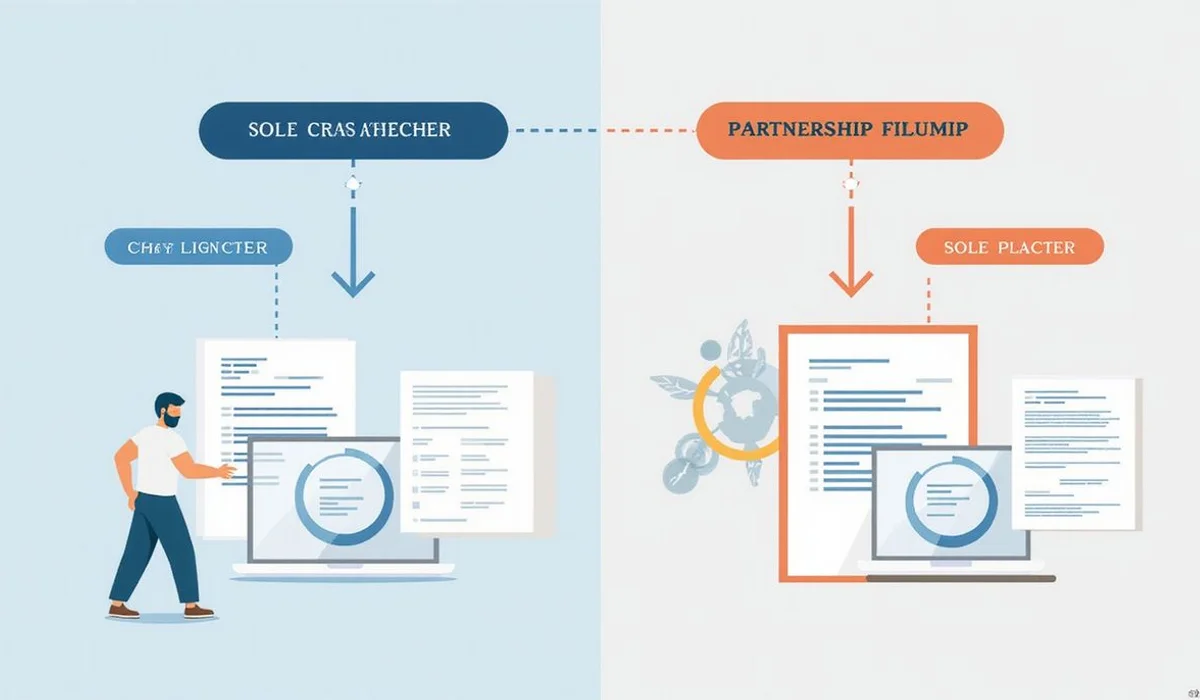
Partnership (Form 1065)
Two or more owners naturally default to a partnership structure if they have not elected corporate status. Multi-member LLCs also fall into this category and must file Form 1065.
The partnership itself does not pay federal income tax. The entity instead issues K-1 forms to each partner to report their individual share of income, deductions, and credits.
Our accounting specialists always warn partners to expect these K-1s by the March 15 filing deadline. You absolutely need this document in hand before you can finalize your personal 1040.
Key Partnership Tax Rules
Before signing a partnership agreement, you should understand how the IRS treats your share of the profits.
- Separate entity return. The 1065 is a distinct filing required every year.
- Self-employment taxes. Active partners generally pay the 15.3% SE tax on their distributive share of ordinary business income.
- Agreement governance. Your written partnership agreement dictates exact profit and loss allocations, not just your ownership percentage.
S-Corporation (Form 1120S)
An S-corp is a tax election, not a base entity, meaning you can form an LLC or a true corporation and then elect S status. These businesses must file Form 1120S.
Much like a partnership, the S-corp itself typically avoids federal income tax by passing profits and losses through to shareholders via a K-1.
We see many Southwest Florida business owners choosing this route specifically to optimize their schedule c vs s corp tax burden. The savings come entirely from how you categorize your earnings.
Active shareholder-employees must take a reasonable salary processed through standard W-2 payroll. The remaining business profit can then be taken as distributions, which are totally exempt from the 15.3% self-employment tax.
S-Corp Compliance Factors
The tax savings must outweigh the administrative costs for this election to make sense.
| Requirement | Detail |
|---|---|
| Filing Deadline | Form 1120S is due March 15. |
| Payroll Setup | Mandatory W-2 processing for active owners. |
| Tax Savings | Distributions bypass the 15.3% SE tax rate. |
| Added Overhead | Separate corporate books and strict formalities are required. |
We cover exactly when this financial trade-off becomes profitable in LLC vs S-Corp in Florida.
C-Corporation (Form 1120)
The standard C-Corporation structure remains fairly uncommon for small Naples service businesses. This entity pays its own taxes at the corporate rate, which sits at a flat 21% federally for 2026.
Shareholders then pay taxes a second time on their personal returns when they receive dividends.
Our corporate tax planners refer to this as the classic double taxation issue. Florida also levies a 5.5% state corporate income tax on C-corps for any net income exceeding $50,000. Most pass-through structures prove far simpler and cheaper for local small businesses.
What “no state income tax” actually means
Florida residents love talking about their tax advantages, but the rules have specific boundaries. The florida no state income tax policy provides three highly concrete financial benefits.
- Untaxed W-2 wages. Your paycheck is not subject to any state-level withholding.
- Protected pass-through income. Business profits from a K-1 or Schedule C go straight to your federal 1040 without a Florida add-on fee.
- Tax-free retirement. Social Security, pensions, and 401(k) distributions are entirely exempt from state taxation.
The Taxes You Still Owe in Florida
Many new residents mistakenly assume “no income tax” means a completely tax-free existence.
You are still fully responsible for federal taxes and local property taxes. Businesses with employees must pay standard payroll and employment taxes, including the reemployment tax which can range up to 5.4% per employee. You must also collect and remit sales tax, which includes the 6% state rate plus any discretionary surtax specific to Collier County.
How to decide which entity is right
Choosing the perfect legal structure shapes your financial future and administrative workload. For most new Naples small businesses, the standard progression path is fairly predictable.
- Start as sole proprietor or single-member LLC. This offers a simple, cheap, and easy filing process.
- Convert to an S-corp election. This move makes sense when your net profit consistently exceeds roughly $50,000 to $80,000.
- Explore partnership structures. Bringing on co-owners requires this shift, but the operating agreement matters far more than the entity type itself.
We know the right choice evolves as your local business expands and revenue scales. Whichever entity you land on, our Naples tax filing service handles the return — Schedule C, 1065, or 1120S — and finds the deductions that come with it. If you are not completely sure where your company stands right now, we cover strategic planning in our tax advisory service. You can also simply book a discovery call for a personalized, one-time consultation.
Frequently Asked Questions
Does Florida have a state income tax?
No. Florida has no personal state income tax, which means W-2 income, business profits, and most retirement income are not taxed at the state level. Federal filing and entity-specific rules still apply.
Do I file a separate return for my LLC?
Depends on the election. Single-member LLCs are treated as disregarded entities and report on the owner's Schedule C. Multi-member LLCs default to partnership treatment (Form 1065). LLCs that elect S-corp status file Form 1120S.
What's the simplest entity for filing?
Sole proprietorship — your business income and expenses go directly on Schedule C of your personal return. No separate business filing, no minimum salary requirement. The trade-off is full self-employment tax exposure and no liability protection.
Related service
Service
Tax Filing
Accurate, on-time tax preparation for individuals and businesses, built to maximize Florida deductions with zero stress.
Related guides
CPA vs. TurboTax: When DIY Filing Costs You Money
When DIY tax software is fine and when it quietly costs you money — audit risk, missed deductions, and where a Naples CPA pays for itself.
What Documents Do I Need to File My Taxes?
Exactly what to gather before filing — W-2s, 1099-NEC, income statements, expense records, and prior returns — for individuals and Naples businesses.
Self-Employed & 1099 Tax Filing in Naples
Freelancer or contractor in Naples? Understand self-employment tax, quarterly estimates, and Schedule C deductions — and avoid common mistakes.
Common Tax Deductions Southwest Florida Business Owners Miss
From Section 179 to home office and vehicle write-offs — the deductions Naples restaurateurs, contractors, and landscapers most often overlook.
Need help with this in Naples?
Book a free discovery call. We'll review your situation, walk you through the options, and respond within 48 hours.
Book a Discovery Call