


When non resident tax filing florida rules apply to seasonal owners
We see a constant influx of seasonal residents interacting with Naples small business owners, from local restaurateurs to contractors, and you know how easily cross-border tax obligations get overlooked.
According to 2026 real estate data, nearly 71% of international demand in Naples comes from Canada alone. This creates a massive overlap between foreign property ownership and local commerce, meaning simple reporting errors impact the local economy.
Our team frequently helps Southwest Florida business owners and seasonal investors clarify their obligations for non resident tax filing florida.
Many foreign nationals end up overpaying simply because they miss a specific form. Let’s look at the data, what it actually means for your tax position, and how to avoid the most expensive filing mistakes.
Are you a US tax resident or non-resident?
We start every client consultation by confirming your exact classification.
The IRS categorizes you as either a tax resident reporting worldwide income or a non-resident alien reporting only US-source income. Your residency status dictates everything from the forms you file to the exemptions you claim.
- US tax resident: You are taxed on worldwide income, regardless of where you earn it. You will file Form 1040.
- US non-resident alien (NRA): You are taxed only on US-source income. You will file Form 1040-NR.
Our tax professionals check three specific tests to determine where you stand.
You cross the line into residency if you meet any of these criteria. The rules are strict, so guessing is never a safe strategy.
- Green card: You hold lawful permanent resident status.
- Substantial Presence Test: You meet a specific, formula-based day count.
- Choice: You make a first-year election to be treated as a resident.
The Substantial Presence Test (SPT)
We constantly see seasonal snowbirds in Naples accidentally trigger this test.
The Substantial Presence Test triggers US tax residency if you spend 31 days in the US during the current year and 183 weighted days over three years. The IRS calculation uses a strict three-year lookback period.
Our firm reminds clients that every single day counts, including weekend trips or quick layovers.
You reach the 183-day threshold through this specific mathematical formula. The government adds these fractions together to determine your status.
- 100% of your days in the current year.
- 1/3 of your days in the prior year.
- 1/6 of your days in the year before that.
We consider 120 days a year to be a safe margin for vacationers.
If you spend 120 days in the US during 2024, 2023, and 2022, your total is exactly 180 days (120 + 40 + 20). That keeps you safely classified as a non-resident.
Our team warns that increasing that stay to 130 days annually pushes your total to 195 days (130 + 43 + 22).
That slight increase makes you a full resident for tax purposes. Even if you pass the 183-day mark, filing Form 8840 can protect your non-resident status through the Closer Connection Exception.
We also review tax treaty tiebreaker rules, like those between the US and Canada, to resolve dual residency conflicts.
You must prove your primary tax home and family ties remain in your home country. Documentation matters heavily during an IRS review.
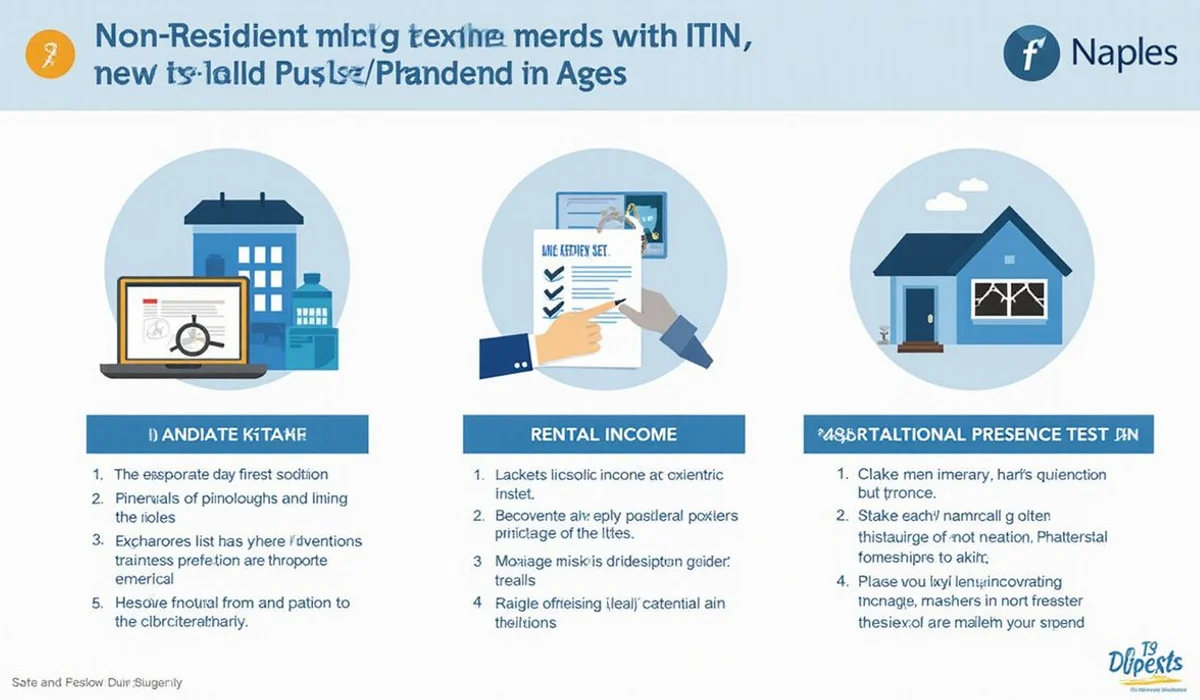
What non-residents must file
We help foreign owners identify which specific income streams trigger a mandatory return.
Non-residents must file Form 1040-NR to report US-source income, such as rental profits, business earnings, or real estate capital gains. The IRS closely monitors these common financial activities.
Our specialists actively work to prevent clients from suffering default withholding penalties.
You can usually elect to be taxed on a net basis instead, which allows you to deduct operating expenses. This simple election drastically lowers the final tax bill for almost every property.
- US-source rental income: Renting out your Naples property requires you to file Form 1040-NR. The default IRS treatment is a massive 30% withholding on gross rent, with zero deductions allowed.
- US-source business income: You must report any earnings from a physical trade or business operating within the US.
- US capital gains: Selling real estate triggers specific tax events. You can review our detailed breakdown with this FIRPTA withholding explained resource.
- US dividends and interest: These are typically hit with a flat 30% withholding tax at the source. Treaty rates often reduce this amount, and it usually acts as your final tax with no return required.
ITIN, getting your tax ID
We handle these applications daily for international investors.
Foreign filers without a Social Security Number must obtain an Individual Taxpayer Identification Number using Form W-7 to process any US tax return. Without this nine-digit code, the IRS will reject your filings.
Our staff highly recommends applying well before the spring tax deadline.
The standard IRS processing time is roughly seven weeks during the off-peak summer and fall months. Wait times regularly stretch to 15 weeks during the peak tax season from January through April 2026.
We track these expiration dates closely for our clients.
You have specific obligations for maintaining this number active. The government requires original documents for verification.
- Application: Submit Form W-7 alongside original or certified copies of your passport. You can file this with your tax return or use a Certified Acceptance Agent.
- Timeline: Expect a 7 to 15-week wait depending on the time of year.
- Renewal: An ITIN expires if you fail to use it on a US federal tax return for three consecutive years.
We assist with ITIN applications as part of our International Tax & FIRPTA service.
A Certified Acceptance Agent can speed up this entire process. Proper documentation prevents immediate rejections.
Net election for rental income
We consider this the most important tax strategy for foreign property owners.
The net election under IRC Section 871(d) allows non-resident landlords to tax their rental income after deducting expenses, rather than paying a flat 30% on gross receipts. By default, the IRS classifies rental earnings as Fixed, Determinable, Annual, or Periodical income.
Our firm sees too many investors blindly accept this massive default withholding.
That means paying taxes on every dollar of rent before accounting for property management fees or repairs. You can change this by making a one-time election statement attached to your Form 1040-NR.
We guide property owners through this switch to net basis taxation.
This simple change provides several major financial benefits. Income is taxed at graduated rates that sit between 10% and 37% for 2026.
- You report your total rental income.
- You deduct allowable expenses like property tax, insurance, landscaping, mortgage interest, and depreciation.
- You pay tax only on the remaining profit.
Our accountants ensure clients file this election to save thousands of dollars annually.
Most seasonal rental properties in Southwest Florida produce minimal net profit after these deductions. A $30,000 gross rental income might owe $9,000 under the default rule, but drop to zero tax liability after expenses.
Tax treaties
We analyze these international agreements to protect your investment returns.
The US maintains tax treaties with numerous countries to prevent double taxation and reduce withholding rates on specific types of income. Residents of Canada, the UK, Germany, and many EU nations can claim significant benefits.
Our tax professionals map out exactly how these treaties affect your specific portfolio.
Every agreement contains unique clauses and specialized exceptions. You must formally claim these benefits on your tax return to receive them.
- Reduced Withholding: Treaties often lower the standard 30% tax rate on dividends, interest, and royalties.
- Residency Resolution: Tiebreaker rules help determine your primary tax home if two countries claim you as a resident.
- Business Exemption: Your foreign business profits might be exempt if you lack a permanent physical establishment in the US.
- Foreign Credits: You can frequently claim credits for taxes already paid to your home country.
We strongly advise against guessing which treaty positions apply to your situation.
The IRS requires precise treaty disclosure forms. Mistakes here trigger immediate audits.
Common snowbird filing situations
We classify our Naples clients into a few distinct operational profiles.
Every seasonal owner faces a different filing requirement based on their property usage, rental activity, and physical presence in the US. Your exact combination of assets determines your seasonal owner tax strategy.
Our team encounters these specific scenarios most frequently.
You should match your personal situation to one of these common profiles. The rules change dramatically if you hold property inside an entity structure.
- Pure non-resident with rental property: You file an annual 1040 nr naples return with a net election. This covers your income, expenses, and asset depreciation.
- Snowbird approaching the day count threshold: You must track your travel dates rigorously. Filing a Closer Connection statement is a smart defensive move.
- Seasonal owner with no rental: You have no filing requirement if you earn no US-source income. A sale will trigger a mandatory FIRPTA withholding, which sits at a standard 15% rate for 2026 sales.
- Foreign LLC holding US property: Entities face entirely different compliance rules and often require their own corporate returns.
- Foreign owner with US-citizen children: Your estate planning is heavily affected by cross-border regulations.
We routinely adjust strategies as our clients transition from casual vacationers to active landlords.
Proper planning prevents surprises during tax season. Selling property always requires advanced calculations.
Penalties for non-filing
We warn every foreign investor that the IRS aggressively enforces these deadlines.
Failing to file a required Form 1040-NR can result in severe financial penalties, including the permanent loss of all tax deductions. Ignoring your obligations will eventually cost you far more than standard compliance.
Our experts frequently rescue clients from these severe IRS enforcement actions.
The consequences extend far beyond simple late fees. The IRS data shows that roughly 64% of taxpayers actually receive refunds, meaning you might be abandoning your own money by failing to file.
- Failure to file Form 1040-NR: You face penalties, mounting interest, and the complete loss of treaty benefits.
- Loss of the net election: If you miss the filing window, the IRS permanently denies your deductions and taxes you at 30% on gross rental income.
- Trapped FIRPTA refunds: You cannot recover excess withholding from a property sale without filing a complete tax return. The standard 2026 FIRPTA rate takes 15% of your gross sale price.
- Backup withholding: The IRS mandates a 24% tax deduction on US-source income for unidentified payees.
We secure far better outcomes for clients who voluntarily come into compliance.
If you have been collecting rent without filing, you need to fix the situation immediately. Waiting for an IRS audit guarantees maximum financial penalties.
Our specialists are ready to help you manage your non resident tax filing florida requirements and get your accounts current.
You can schedule a time to Book a confidential consultation to discuss your exact needs. The consultation is available across English, Spanish, and other languages.
Frequently Asked Questions
Do foreign owners pay US tax on Naples rental income?
Yes. US-source rental income is generally taxable and must be reported. By default, gross rental income is taxed at 30% with no deductions allowed. You can elect to be taxed on a net basis (after expenses) which usually results in lower tax.
What is an ITIN and do I need one?
An Individual Taxpayer Identification Number, required for foreign filers without a Social Security Number. Needed to file US tax returns, claim refunds, and process FIRPTA withholding. Apply via Form W-7.
Does spending winters in Naples make me a US tax resident?
Potentially yes, via the Substantial Presence Test. Roughly: if you're in the US 183+ days in a 3-year weighted average, you become a US tax resident. Snowbirds need to track days carefully or risk unintentionally becoming US tax residents.
Related service
Service
International Tax & FIRPTA
FIRPTA withholding and non-resident tax compliance for foreign sellers, seasonal expats, and foreign real-estate investors across Southwest Florida.
Related guides
FIRPTA Withholding Explained for Naples Real Estate Sellers
What FIRPTA is, how the 15% withholding works on Naples real estate sales, who it applies to, and the foreign seller's obligations.
How Foreign Sellers Can Reduce or Recover FIRPTA Withholding
How foreign sellers can reduce or reclaim FIRPTA withholding — withholding certificates (Form 8288-B), reduced-rate exceptions, and the refund timeline.
Need help with this in Naples?
Book a free discovery call. We'll review your situation, walk you through the options, and respond within 48 hours.
Book a Discovery Call