


The 20% QBI deduction, who qualifies, and how
Tax planning often feels like a moving target for local contractors and restaurateurs here in Southwest Florida. We see the qualified business income deduction as the most effective tool for keeping more cash in your pocket.
The recent passage of the One Big Beautiful Bill Act (OBBBA) finally made this 20 percent pass through deduction a permanent fixture for 2026 and beyond. This legislation means you no longer have to worry about the deduction expiring.
Missing the nuances of this tax code leaves thousands on the table or triggers an IRS audit. Our team wants to break down the exact framework so you can confidently claim what is yours.
What QBI is
The QBI deduction is a federal tax break allowing eligible self-employed individuals to deduct up to 20% of their qualified business income. To make your qbi deduction qualify, you apply this deduction to pass-through entities like sole proprietorships, partnerships, S-corps, and trusts after computing net profit but before calculating personal income tax.
We consider this an automatic and substantial benefit for most Naples small business owners. The 2026 OBBBA legislation even introduced a new minimum deduction of $400 for active businesses generating at least $1,000 in qualified business income. This guarantees that even part-time landscapers or Fifth Avenue South boutique vendors get a baseline tax break.
Here is a quick breakdown of entity eligibility:
| Entity Type | Eligible for QBI? | Typical Local Examples |
|---|---|---|
| Sole Proprietorship (Schedule C) | Yes | Independent contractors, freelance designers |
| S-Corporation | Yes | Local construction firms, medical practices |
| Partnership / LLC | Yes | Multi-owner restaurants, real estate groups |
| C-Corporation | No | Large corporate retail chains |
Our professionals always check entity status first before running any calculations.
The income threshold
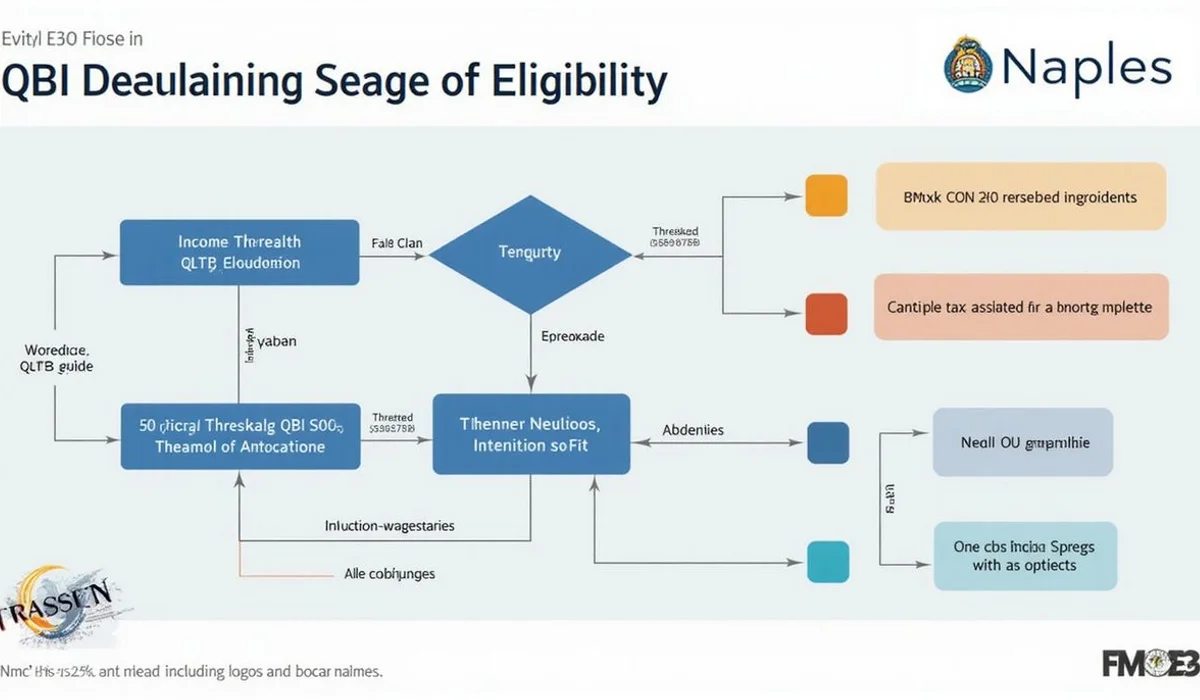
QBI qualification operates on a strict two-tier structure based on your total taxable income reported on your Form 1040. The IRS adjusts these limits annually for inflation. We track these numbers closely because crossing a threshold changes your entire tax strategy.
For the 2026 tax year, the limits have increased significantly. You receive the full 20% deduction with no additional limitations if your income stays below these marks:
- Married Filing Jointly: $403,500
- All Others: $201,750
Our clients who earn above those marks enter the phase-in range. The deduction becomes partial, and complex limits begin to apply based on your business type:
- Phase-in range (Married Filing Jointly): $403,500 to $553,500
- Phase-in range (All Others): $201,750 to $276,750
Different rules completely take over once your income surpasses the top end of the phase-in range.
SSTB versus non-SSTB
The IRS classifies a Specified Service Trade or Business (SSTB) as an operation where the principal asset is the reputation or skill of its employees or owners. This classification dramatically impacts your ability to claim the deduction at higher income levels. We spend significant time analyzing how local businesses categorize their services.
The government strictly defines the following fields as SSTBs:
- Health (doctors, dentists)
- Law
- Accounting
- Actuarial science
- Performing arts
- Consulting
- Athletics
- Financial and brokerage services
- Investment management
Our financial advisors warn clients that if your business is an SSTB and your taxable income lands above the phase-in range, you get zero QBI deduction for that entity.
Non-SSTB businesses operate differently. Local Collier County trades, construction companies, manufacturing plants, Third Street South retail stores, and hospitality venues fall into the non-SSTB category. The deduction continues for these business owners even above the income threshold, subject to specific wage and property limitations.
The wage-and-property limitation (above threshold, non-SSTB)
High-earning non-SSTB owners face a mathematical test to determine their final tax break. The IRS limits your QBI deduction to the greater of two calculations once you cross the top income threshold. We run these projections year-round to ensure optimal outcomes.
You must calculate both of the following options:
- 50% of the W-2 wages paid by the business
- 25% of W-2 wages plus 2.5% of the unadjusted basis of qualified property
This exact formula is why some Naples business owners structure their S-corp salaries strategically. Paying enough wages preserves the deduction, while paying too little triggers the limitation and disqualifies your savings. Our firm actively monitors these ratios for local entrepreneurs.
Let us look at a quick comparison to show the impact:
| Scenario (Non-SSTB above threshold) | W-2 Wages Paid | Unadjusted Property Basis | Resulting QBI Limit |
|---|---|---|---|
| High Wage Focus | $100,000 | $10,000 | Limited to $50,000 |
| High Property Focus | $20,000 | $1,000,000 | Limited to $30,000 |
Common QBI mistakes we see
Business owners frequently leave money on the table due to simple oversights. We review hundreds of returns every season and notice the same costly errors repeating themselves.
Underestimating reasonable salary on S-corps
A low S-corp salary can save self-employment tax but disqualify part of your QBI above the income thresholds. The IRS strictly looks at replacement cost and market data to determine if your compensation is reasonable. We recommend checking out our guide on LLC vs S-Corp in Florida for more details. Finding the exact right salary balances both payroll taxes and deduction limits.
Missing the retirement contribution pitfall
Many business owners aggressively fund their SEP-IRA or 401(k) to lower their taxable income. This strategy actually reduces your qualified business income base, meaning your 20% deduction shrinks. Our tax planners always run the math to see if the retirement tax deferral outweighs the lost QBI benefit.
Mischaracterizing the business as non-SSTB
Consultants and accountants clearly operate as SSTBs even if they label themselves differently on marketing materials. The IRS aggressively targets misclassification during audits. We ensure all operations get assigned the proper code from day one.
Stacking multiple businesses incorrectly
Aggregating multiple businesses can help or hurt depending on your specific wage and property figures. Grouping a high-wage business with a low-wage business might maximize the deduction. Our team analyzes every possible combination to find the highest legal return.
Ignoring the Section 179 vehicle trap
Buying a heavy SUV over 6,000 pounds yields a massive Section 179 deduction, capped at $28,900 for 2026. Taking this massive immediate deduction lowers your net business income, which proportionately lowers your QBI deduction. We help clients weigh the value of the equipment write-off against the pass-through tax break.
Florida-specific notes
Florida residents enjoy a structural advantage regarding pass-through income. The absence of a state income tax means your federal QBI deduction delivers maximum impact without state-level offsets. We remind our local clients that the full 20% stays right in their bank accounts.
Southwest Florida presents a unique demographic challenge that complicates tax planning. The Naples real estate market remains strong, with single-family median home prices hovering around $800,000 in 2026. This immense local wealth means many business owners easily push past the $403,500 phase-in threshold.
Our most successful clients monitor two specific regional factors:
- High local revenue: Strong local pricing power easily inflates net profits beyond safe harbor limits.
- Dual-state residency: Snowbirds with multi-state filings must coordinate federal deductions with passive income laws in their northern state.
What to do if you’re near the threshold
Year-end planning becomes absolutely critical for Naples business owners hovering near the income limits. Strategic moves dictate whether you get a 20% discount on your taxes or pay full price. We execute these specific strategies with clients every Q4.
Consider these actionable steps before the year ends:
- Maximize retirement contributions to lower your total taxable income below the phase-in range.
- Defer December income into January if you will exceed the threshold this year but expect lower revenue next year.
- Accelerate deductible expenses by purchasing supplies or paying vendors before December 31.
- Consider charitable contributions if you plan to itemize your personal deductions.
- Time equipment purchases to utilize Section 179 depreciation in the higher-tax year.
These decisions require action before December 31. Our advisors stress that waiting until April is simply too late to change the math.
When to engage advisory specifically for QBI
Strict tax codes demand proactive management. A dedicated Tax Advisory engagement makes financial sense if your taxable income consistently lands within 20% of the threshold limits.
We have seen this single deduction shift federal tax liabilities by tens of thousands of dollars based entirely on December decisions. Do not guess on compliance or leave money behind.
You can easily Book a discovery call to discuss your specific situation and start building a better strategy.
Frequently Asked Questions
Who qualifies for the QBI deduction?
Most pass-through owners — sole proprietors, partners, S-corp shareholders, and trust beneficiaries — with qualified business income below the income thresholds. Above thresholds, limits apply differently for service businesses (SSTBs) than non-service businesses.
Does an S-corp owner get QBI?
Yes, on the K-1 pass-through portion of business income (not on W-2 wages paid to themselves). Subject to wage and threshold limits.
Does Florida's lack of state income tax affect QBI?
No — QBI is a federal deduction calculated identically regardless of which state you're in. Florida residents just don't get the same kind of state-level pass-through tax issues other states' residents do.
Related service
Service
Tax Advisory Services
Proactive, year-round tax planning that uncovers hidden deductions and minimizes your tax burden — a growth tool for business owners and freelancers.
Related guides
LLC vs. S-Corp in Florida: Which Saves More Tax?
LLC vs. S-Corp in Florida — how the S-corp election saves self-employment tax, reasonable-salary rules, and when each structure makes sense.
Tax Loss Harvesting and Capital Gains Planning
How tax-loss harvesting works, short- vs long-term gains, and timing strategies for higher-earning Collier County professionals planning around gains.
When Should a Business Hire a Year-Round Tax Advisor?
The signs it's time to move from seasonal filing to a year-round tax advisor — growth, multiple entities, complexity — and the ROI of doing it.
Year-End Tax Strategies for Contractors and Landscapers
Actionable year-end tax moves for SWFL contractors and landscapers — equipment timing, retirement contributions, and income/expense deferral.
Need help with this in Naples?
Book a free discovery call. We'll review your situation, walk you through the options, and respond within 48 hours.
Book a Discovery Call