


Retirement tax planning for Naples and SWFL professionals
We know that for Collier County professionals approaching or in retirement, tax planning often produces larger lifetime returns than investment selection. The decisions about which accounts to fill during work, when to convert to Roth, and how to draw down in retirement can change effective lifetime tax rates by 5 to 15 percent. This kind of shift easily translates to many tens or hundreds of thousands of dollars over decades.
Our team sees the same pattern with Naples small business owners year after year. Most entrepreneurs focus entirely on top-line revenue while neglecting the silent drag of inefficient retirement tax planning southwest florida. That oversight becomes glaring when you realize the 2026 standard deduction for married couples filing jointly is now $32,200.
We use this exact number as the baseline for protecting your hard-earned wealth.
Let us look at the data, what it actually tells us, and explore a few practical ways to respond. The right moves today will secure your financial independence tomorrow.
The Florida advantage in retirement
Our advisors constantly remind clients that establishing Florida residency requires more than just spending winters here. Florida residents hold a massive structural retirement advantage because the state levies zero income tax on pensions, IRA withdrawals, or capital gains. A high-earning retiree moving from New York or California automatically keeps between 5 and 13.3 percent more of their income each year.
We highly recommend formally filing a Declaration of Domicile with the Collier County Clerk to prove your intent. The old “six months and a day” rule, or 183-day rule, is heavily monitored by northern tax auditors looking for revenue. You need documented proof of your transition, so see how to establish Florida residency for the complete checklist.
We love seeing clients secure the three specific tax benefits of being fully domiciled here.
- First, there is no state tax on retirement income, meaning your 401(k) distributions and Social Security are completely clear.
- Second, you face no state tax on investment income, letting your capital gains grow without local friction.
- Third, there is no state estate tax for heirs.
Our financial plans always account for the federal layer that still applies. You simply avoid stacking state taxes on top. Careful planning maximizes this incredible geographic shield.
The three account “buckets”
We categorize every dollar you save into one of three specific tax treatments. Retirement tax planning operates across these distinct types of accounts, each carrying drastically different IRS rules. The order in which you pull money from these buckets determines your total lifetime tax bill.
Our approach isolates the unique advantages of each account type to build a tax-efficient withdrawal strategy. The SECURE 2.0 Act made this even more critical now that the 2026 Required Minimum Distribution (RMD) age sits at 73 for most recent retirees. Failing to balance these buckets properly often triggers higher Medicare premiums later in life.
Understanding your tax categories
We find that most professionals end retirement with money scattered across all three columns. You likely hold a mix of these accounts if you are nearing the end of your career. The specific sequence you use to draw these down affects your net wealth materially.
| Account Category | Tax Treatment | 2026 IRS Rules & RMDs | Common Examples |
|---|---|---|---|
| Taxable | Taxed annually on dividends/interest and at sale (capital gains). | No RMDs. Withdrawals of principal are not taxed. | Vanguard Brokerage, Bank Savings |
| Tax-Deferred | Contributions are deductible. All withdrawals taxed as ordinary income. | RMDs mandatory at age 73 (born 1951-1959). | Traditional 401(k), Traditional IRA, SEP IRA |
| Tax-Free (Roth) | Contributions taxed upfront. Growth and withdrawals are 100% tax-free. | No RMDs during the original owner’s lifetime. | Roth IRA, Roth 401(k) |
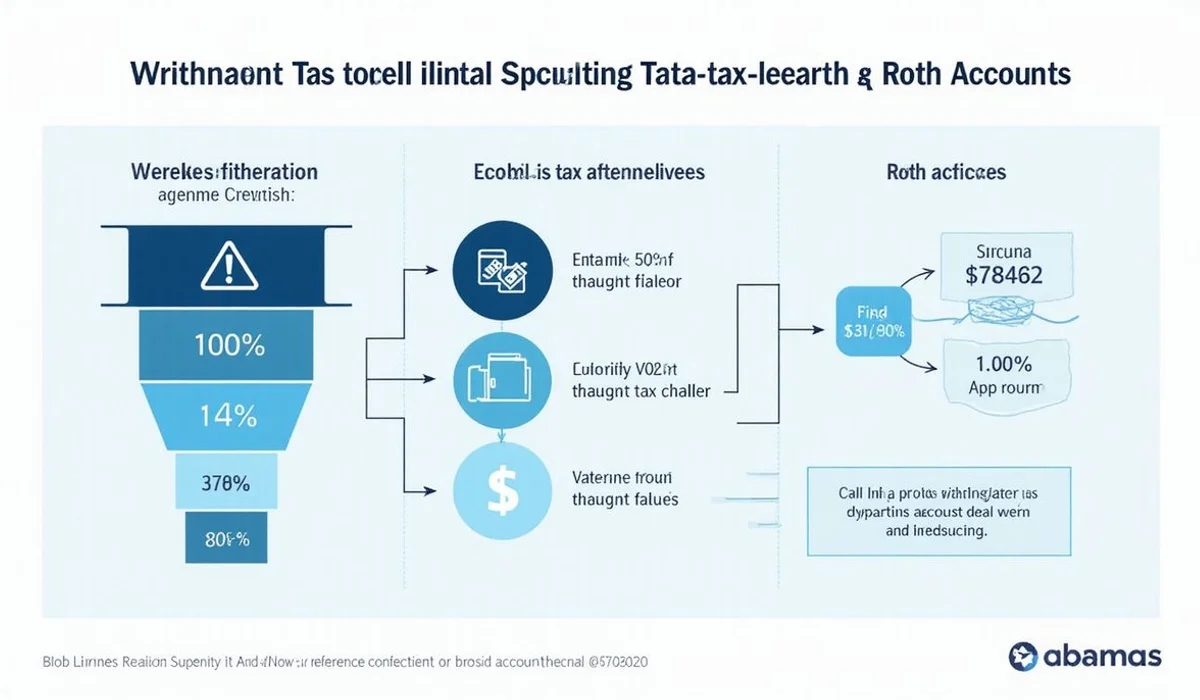
Our team uses customized graphics to illustrate these concepts clearly. Visualizing your assets makes the withdrawal process much less intimidating. The diagram below highlights a standard distribution flow.
Withdrawal sequencing, the conventional vs strategic answer
We see the traditional withdrawal method creating a massive “tax torpedo” for many retirees in their 70s. A strategic withdrawal plan actively manages your tax brackets rather than blindly following outdated advice. Conventional wisdom suggests drawing from taxable first, tax-deferred second, and Roth last to maximize deferral, but this often causes severe tax shocks.
Our process breaks the retirement timeline into three actionable phases to prevent stacked taxes. Letting your traditional IRA grow untouched until age 73 forces massive, mandatory taxable withdrawals. Those required payouts easily push a Naples retiree into the 24 percent or 32 percent federal bracket.
Ages 60 to 72 (The pre-RMD window)
We use this pre-RMD phase to intentionally shrink your traditional IRA balance before the IRS forces your hand. This decade represents your golden window for ultimate tax control. You can dictate exactly how much income appears on your tax return by pulling living expenses from taxable accounts.
Our clients typically pull a modest amount from tax-deferred accounts up to the edge of the 12 percent bracket. The remaining space in the 22 percent or 24 percent brackets is then used to execute calculated Roth conversions. Entering age 73 with less tax-deferred money guarantees significantly smaller future RMDs.
Ages 73 and beyond (The RMD years)
We ensure clients never accidentally push themselves into a higher Medicare IRMAA surcharge bracket during this distribution phase. The IRS absolutely dictates a portion of your income once you hit age 73. You must take your mandatory RMDs from tax-deferred accounts first, supplementing any remaining cash needs with tax-free Roth withdrawals.
Our monitoring of the $201,775 joint income threshold prevents costly Medicare premium spikes. You can still continue strategic Roth conversions if you experience a year with high medical deductions to offset the income. Careful execution keeps your overall effective tax rate remarkably low.
Late retirement and legacy planning
We prefer leaving Roth or taxable assets to your children whenever possible because it provides a cleaner financial legacy. Your different account types pass to your heirs with very different tax burdens attached. Roth accounts transfer to beneficiaries completely income-tax-free, though they are subject to the SECURE Act 10-year payout rule.
Our estate coordination strategies account for the heavy tax hit traditional accounts place on heirs. Beneficiaries must pay their own marginal income tax rates when withdrawing from an inherited traditional IRA. Taxable accounts receive a highly favorable “step-up in basis,” eliminating all capital gains taxes on prior growth.
Roth conversions, the most underused tool
We consider Roth conversions the most powerful lever for Naples business owners holding substantial traditional 401(k) balances. Converting pre-tax retirement funds into tax-free Roth assets saves significant lifetime tax if executed before your RMDs begin. This proactive strategy involves paying taxes intentionally today to lock in a zero percent tax rate for tomorrow.
Our advisors calculate the exact dollar amount needed to “fill up” your current bracket without spilling over into the next. You are essentially buying out the IRS’s share of your retirement account at a steep discount. The 2026 standard deduction of $32,200 for married couples offers a huge buffer to absorb the initial tax impact of these moves.
How a conversion actually works
We run detailed projections to ensure you never convert a single dollar that triggers unnecessary penalties. The mechanics are straightforward, starting with identifying the exact gap between your current income and the top of the 24 percent tax bracket. You transfer that specific amount from your Traditional IRA to your Roth IRA, paying the ordinary income tax using separate taxable funds.
Our favorite aspect of this strategy is that the converted balance now grows completely tax-free forever. The timing requires precision to avoid crossing over a threshold mid-year. Once converted, those funds also completely escape all future RMD requirements.
Best windows for conversions
We actively watch for specific life events that create ideal conditions for moving money to a Roth. The early retirement gap years, sitting between stopping work and claiming Social Security, usually feature your lowest lifetime tax rates. Market downturns present another excellent opportunity, as converting when your account values temporarily drop allows you to move more shares for fewer tax dollars.
Our planning process specifically targets business loss years for local restaurateurs and contractors. Unusually high business deductions can completely offset the taxable income generated by a conversion. Executing these moves transforms market volatility or business expenses into a distinct, permanent tax advantage.
Tax-advantaged accounts to maximize during work
We guide actively working Collier County professionals toward maxing out specific accounts before they retire. The 2026 IRS contribution limits provide massive opportunities to shelter current income. Securing these tax advantages now directly impacts your withdrawal flexibility later.
Top savings vehicles for high earners
Our first recommendation is always capturing the full employer match in your workplace 401(k) because it represents free money. You should continue funding that 401(k) up to the 2026 employee limit of $24,500 if your cash flow permits. Keep in mind that under SECURE 2.0 rules starting in 2026, high earners making over $145,000 must make their catch-up contributions as Roth funds.
We also utilize the Backdoor Roth IRA for clients whose income exceeds the 2026 phase-out limit of $242,000 for married couples. This involves making a non-deductible IRA contribution of $7,500 and executing an immediate Roth conversion to bypass the income ceiling. A Mega-backdoor Roth strategy can shelter substantial additional amounts if your specific 401(k) plan allows after-tax contributions and in-plan conversions.
We rank the Health Savings Account (HSA) as the most efficient tax-advantaged account available if you qualify through a high-deductible health plan. It is triple tax-advantaged, offering deductible contributions, tax-free growth, and tax-free medical withdrawals. Self-employed individuals should heavily consider setting up a SEP IRA or Solo 401(k), which you can explore further in our SEP IRA vs Solo 401(k) breakdown.
Social Security claiming strategy
We analyze every client’s earnings history to pinpoint the exact month they should file for benefits. Delaying Social Security from age 62 to 70 increases the monthly payout by roughly 8 percent per year of delay. Waiting until age 70 in 2026 secures the absolute maximum benefit of $5,181 per month for high earners who consistently hit the taxable wage base limit.
Our advice for most Naples retirees with health and financial flexibility is to delay claiming if other investment income covers the gap. Married couples must coordinate their filing strategies, as the higher-earning spouse usually benefits most from delaying to maximize the survivor benefit. Filing for full benefits at your full retirement age of 66 or 67 serves as a strong middle ground.
We love reminding residents that while Social Security is partially taxable at the federal level, it is never taxable by Florida. The federal taxation depends entirely on your combined provisional income. Proper withdrawal sequencing keeps that provisional income low, protecting more of your Social Security check.
Health-care timing
We coordinate retirement withdrawals closely with healthcare premiums to prevent hidden cost spikes. Retirees pre-Medicare, before age 65, often need health insurance through the ACA marketplace. ACA subsidies are strictly based on Modified Adjusted Gross Income (MAGI), which includes IRA withdrawals and Roth conversions.
Our tax projections actively plan around the return of the ACA “subsidy cliff” in 2026. Middle-income earners making above 400 percent of the Federal Poverty Level, roughly $62,600 for a single person, risk losing their enhanced premium assistance entirely. Careful timing of your Roth conversions prevents a sudden, drastic spike in your monthly health insurance bill.
Estate coordination
We view retirement decisions as deeply intertwined with your overarching estate planning goals. The 2026 federal estate tax exemption sits at an historic $13.99 million per individual, but income taxes on inherited accounts remain a major threat to wealth transfer. Tax-deferred accounts come to heirs with a built-in income tax liability, forcing them to drain the account and pay taxes within a 10-year window under current SECURE Act rules.
Our use of strategic Roth conversions actively reduces the size of your taxable estate while pre-paying the income tax for your beneficiaries. The choice of which bucket you draw from during your lifetime dictates exactly what your heirs actually receive net of taxes. Proper structuring requires a localized approach, which you can read about in this overview of estate and gift tax for Collier County families.
Engagement
We treat naples retirement tax planning as an active, annual exercise rather than a one-time event. The process requires you to consistently assess your current bracket, decide on a Roth conversion amount, and project the next year’s income. Keeping a sharp eye on IRS changes ensures your strategy never falls behind the current law.
We handle this entire lifecycle of bracket management as a core part of our Financial Planning service. Professionals within ten years of stepping away from their practice see the most substantial value from this proactive modeling. Take the first step and Book a discovery call to discuss your specific withdrawal timeline.
Frequently Asked Questions
Does Florida tax retirement income?
No state income tax means no Florida tax on retirement income — pensions, IRA withdrawals, 401(k) distributions, Social Security are all state-tax-free. Federal rules still apply.
What order should I draw down retirement accounts?
The general principle: taxable accounts first, then tax-deferred (traditional IRA/401k), then Roth — but with significant exceptions based on RMD requirements, tax bracket management, and estate goals. Sequencing strategically can lower lifetime tax by 5–15%.
When should I do a Roth conversion?
Typically in low-income years — early retirement before Social Security and RMDs, gap years, market downturns. The trade-off: pay tax now at low rates, eliminate tax forever on the converted amount and its future growth.
Related service
Service
Financial Planning
Tax-led financial planning for Southwest Florida residents — Florida residency strategy, retirement, and business-owner wealth, built around tax efficiency.
Related guides
How to Establish Florida Residency to Avoid State Income Tax
How snowbirds establish Florida domicile to legally avoid out-of-state income tax — the 183-day rule, domicile factors, and documentation.
SEP IRA vs. Solo 401(k) for Self-Employed Floridians
SEP IRA vs. Solo 401(k) for self-employed Floridians — contribution limits, setup and admin differences, tax treatment, and which plan fits.
Need help with this in Naples?
Book a free discovery call. We'll review your situation, walk you through the options, and respond within 48 hours.
Book a Discovery Call