


You know how quickly a sunny Naples afternoon turns stressful when a thick envelope from the Department of the Treasury arrives. Our team regularly sits down with local restaurateurs and contractors who feel completely blindsided and unsure of what to expect during an IRS audit.
The truth is that an examination is rarely a punishment. It is simply a procedural check to verify that your filed return matches your actual financial records.
We are going to break down exactly what happens during this process and outline the practical steps you can take to protect your business.
Let’s look at the current 2026 data, what these notices actually mean, and how you can respond effectively.
Walking through an actual IRS audit
Our clients often ask us what to expect during an IRS audit once the initial shock wears off. Recent 2026 data shows that the total individual examination rate remains low, hovering around 0.2% to 0.5%.
That percentage jumps significantly if you file a Schedule C for a small business with high deductions.
We always remind taxpayers that preparation lowers anxiety. The agency uses a specific document called Form 4564, also known as an Information Document Request.
This form spells out exactly what records they need to see. For most taxpayers who maintain clean bookkeeping, the process ends with no change or a minor adjustment.
The three types of IRS audit
Not all government inquiries carry the same weight. The agency utilizes three distinct formats depending on the complexity of your tax return.
Our firm handles all three variations, and each requires a different strategy.
| Audit Type | Location | Severity Level |
|---|---|---|
| Correspondence | By Mail or Secure Portal | Low (Targeted items only) |
| Office | Local IRS Branch | Medium (In-person interview) |
| Field | Your Business or Home | High (Comprehensive review) |
Correspondence audit
By far the most common format, making up about 75% of all cases. The agency sends a letter requesting proof for specific items, such as vehicle mileage deductions or charitable contributions. You simply mail or upload copies of your receipts through a secure portal. They review the files and mail a response back. No in-person meeting is required.
Office audit
You must visit a local branch office for an in-person interview. The assigned agent will bring a focused list of items to discuss, which usually covers a few specific income sources or deductions. These meetings typically last two to four hours.
We find this format more serious than a mail review, but it remains highly focused.
Field audit
This is the most comprehensive examination. A Revenue Agent visits your home, your landscaping yard, or your restaurant to inspect records on-site. The government reserves this format for high-income earners, complex business returns, and cash-intensive operations. These onsite reviews may extend across multiple visits over several months.
If you receive an official notice, identifying the format immediately tells you what level of scrutiny to expect.
What the IRS will ask for
Official notices will include the Information Document Request (IDR) listing exact requirements. The government does not have to take your word for anything. Documentation is your only defense, and items without physical proof are typically disallowed.
Our team emphasizes that contemporaneous records (logs created at the exact time of the event) carry much more weight than reconstructed spreadsheets. The examiner will typically demand documentation covering a three-year period.
Typical items requested include:
- Bank statements and prior year tax returns
- Point-of-sale receipts and vendor invoices
- Detailed daily mileage logs (crucial for contractors)
- Home office documentation (blueprints, photos, utility bills)
- Payroll and employee classification records
- Asset purchase contracts and loan documents
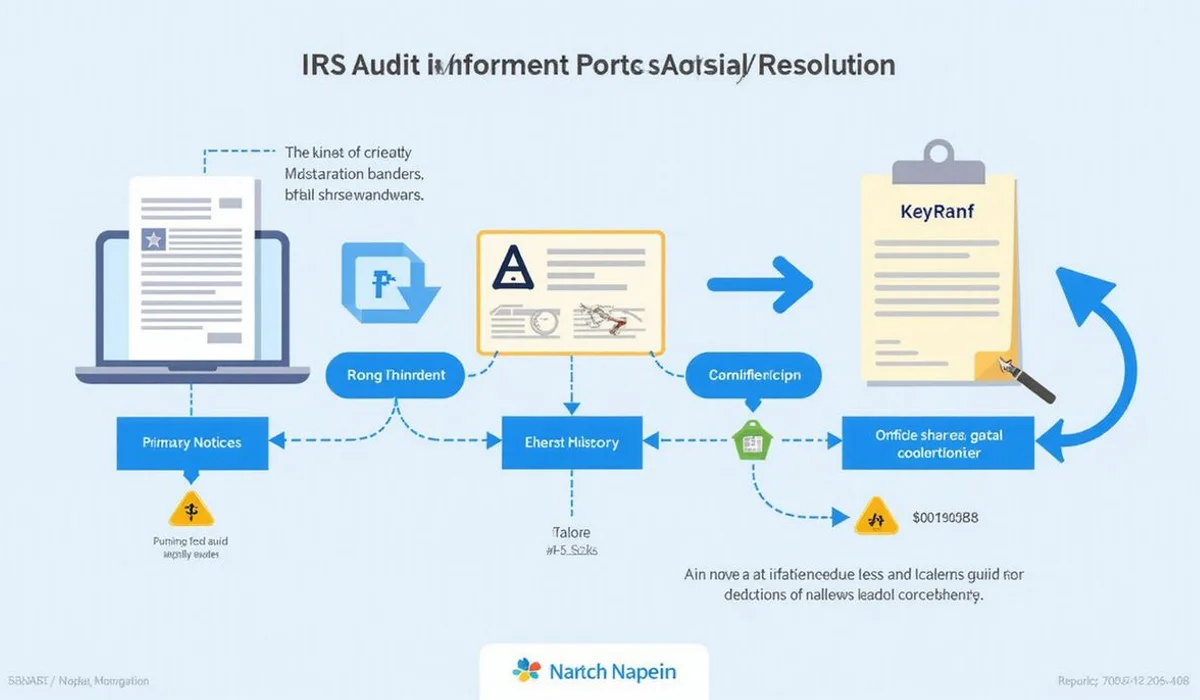
The audit process, step by step
Understanding the irs audit process keeps you in control of the timeline. The procedure follows a strict path from the first letter to the final resolution.
Our tax professionals follow this standard sequence for every single case.
- Notice and Representation. The initial letter specifies the exact years under examination and sets a strict deadline. You will sign Form 2848 to grant Power of Attorney so the government communicates directly with your representative rather than calling you.
- Document Gathering. Pull everything requested in the IDR immediately. Where original receipts are missing, you must reconstruct the paper trail using secondary sources like credit card statements or supplier invoices.
- Submission and Meeting. For mail-based reviews, you send the copies via certified mail. For field examinations, you or your representative must stick strictly to the questions asked and never volunteer extra information outside the stated scope.
- Preliminary Findings. The examiner will present proposed adjustments, outlining which items they plan to disallow and calculating any additional tax owed.
- Resolution and Closing. You can negotiate many adjustments directly at the agent level by providing better context. Finally, you either sign Form 4549 (Income Tax Examination Changes) to agree and pay, or you initiate a formal appeal.
Appealing audit results
If the initial agent issues an unfavorable ruling, you are not out of options. You have formal rights to challenge their findings.
Our strategy usually starts with the independent administrative review process. Most disagreements resolve at this level or below, making a full trial exceptionally rare.
Your primary appeal options
- IRS Appeals. You can request a formal review by the Appeals Office, which operates independently from the examination division. This route boasts a strong success rate for cases featuring documented disagreements on facts or tax law interpretation.
- U.S. Tax Court. You can petition the Tax Court by filing a formal dispute and paying a $60 filing fee. This action stops all collection efforts during the active case, and you do not have to pay the disputed tax beforehand. You must file this petition within 90 days of receiving your Statutory Notice of Deficiency.
- District Court or Court of Federal Claims. This path requires you to pay the disputed tax bill first. After paying, you sue the government for a refund, which makes this option far less common for small businesses.
Penalties and interest in an audit
If the final resolution results in additional tax owed, the billing statement will include more than just the base tax. The government aggressively applies financial penalties to underpayments.
We always warn clients that these extra fees can quickly double a tax bill if left unmanaged.
Standard penalties and interest rates
- Interest. The agency sets underpayment interest rates quarterly, which currently sit at 6% for the second quarter of 2026. This interest compounds daily, starting from the original due date of the return.
- Failure-to-pay penalty. This penalty adds 0.5% for each month the tax remains unpaid. It maxes out at 25% of the total unpaid tax.
- Accuracy-related penalty (20%). Examiners apply this 20% surcharge if they determine the underpayment resulted from negligence or a substantial understatement of income.
- Fraud penalty (75%). This is a rare but extreme penalty. The government reserves it strictly for cases involving willful, intentional tax evasion.
You can often negotiate to have accuracy-related penalties removed by demonstrating reasonable cause and good faith. See our penalty abatement guide for the exact steps to request this relief.
What helps and what hurts
During an active examination, your behavior and organization directly impact the final dollar amount. A cooperative but highly disciplined approach yields the best results.
Our defense strategy focuses heavily on controlling the flow of information.
Actions that help your case
- Keeping comprehensive, organized records ready for immediate review.
- Hiring professional representation to speak on your behalf.
- Sticking strictly to the stated scope of the inquiry.
- Responding to all letters and document requests before the deadlines.
- Cooperating politely without volunteering unnecessary stories or opinions.
Actions that hurt your case
- Handing over unorganized boxes of missing or illegible documentation.
- Trying to handle a complex field examination alone.
- Talking too much during interviews. Auditors frequently expand their scope based on offhand comments about new vehicles or expensive vacations.
- Missing official deadlines, which can trigger default judgments against you.
- Antagonizing the examiner or acting defensively.
Common Naples-area audit scenarios
Operating a business in Southwest Florida presents unique compliance challenges. The local economy relies heavily on service trades, hospitality, and seasonal residents, which attracts specific government scrutiny.
Our local CPA team provides dedicated Naples IRS audit help because we see very distinct enforcement patterns targeting small businesses in Collier and Lee counties.
High-risk triggers for local businesses
- Worker misclassification. Landscaping and construction firms frequently face audits over issuing 1099s to workers who should be W-2 employees. The government uses a strict “common law test” to evaluate behavioral and financial control over the worker.
- Cash-intensive operations. Restaurants and salons trigger alerts if they fail to file Form 8300 for cash transactions exceeding $10,000.
- Schedule C consecutive losses. If your business reports a loss for three out of five years, the examiner may invoke the “hobby loss” rule and disallow all your business deductions.
- Unsupported deductions. Claiming 100% business use for a vehicle without daily mileage logs or deducting a home office without exclusive-use evidence guarantees a rejection.
- FIRPTA mismatches. Discrepancies between property sale documentation and reported gains for foreign sellers are common here. See our guide on International Tax & FIRPTA for more details.
- Multi-state filings. Snowbirds claiming Florida residency while operating businesses up north face heavy residency verification checks.
Bottom line
Most reviews end with minor adjustments or no changes at all. The single biggest factor in your defense is the quality of your documentation at the time of filing.
We know that accurate, year-round bookkeeping is the ultimate audit defense strategy.
If you are still wondering what to expect during an IRS audit for your specific situation, contact us within 48 hours of receiving the notice for a strategy review. See also our guide on what to do when you receive a CP2000 and learn about our broader IRS Tax Resolution service.
Frequently Asked Questions
How long does an IRS audit take?
Correspondence audits often resolve within 4–8 weeks. Office audits typically run 3–6 months. Field audits — the most comprehensive — can take 6 months to over a year depending on complexity and how cooperative both sides are.
Should I talk to the IRS myself during an audit?
Usually better to have a representative communicate on your behalf under power of attorney (Form 2848). Tax law nuances, scope-management, and the dynamics of an audit interview benefit from professional presence — taxpayers often volunteer information that broadens the audit.
What triggers an IRS audit?
Common triggers include math errors, mismatched 1099 income, unusually large deductions relative to income, home office or vehicle deductions that look outsized, Schedule C losses claimed repeatedly, and statistical anomalies the IRS Discriminant Index Function flags. Some audits are entirely random.
Related service
Service
IRS Tax Resolution
Comprehensive IRS audit representation and back-tax resolution — we guide you through the entire inquiry with Florida-specific risk mitigation.
Related guides
How to Handle Unfiled Back Taxes
Behind on multiple years of returns? How to get compliant, what substitute returns are, statute-of-limitations basics, and the path to resolution.
What to Do When You Receive an IRS Audit Letter (CP2000)
Just received an IRS CP2000 or audit letter? First-response steps, what it means, your deadline to respond, and when to bring in representation.
IRS Penalty Abatement: How to Remove Tax Penalties
How to reduce or remove IRS penalties — first-time abatement, reasonable-cause criteria, which penalties qualify, and how the request works.
Offer in Compromise vs. IRS Installment Agreement
Offer in Compromise vs. an IRS installment agreement — eligibility, pros and cons, typical outcomes, and which back-tax path fits your situation.
Need help with this in Naples?
Book a free discovery call. We'll review your situation, walk you through the options, and respond within 48 hours.
Book a Discovery Call