


Federal tax filing deadlines: the dates that actually matter
We notice that managing cash flow often takes priority over tracking the IRS calendar for many local business owners. As a professional service team, we treat these dates as critical financial milestones rather than just compliance tasks.
Tax filing deadlines and extensions are simply tools you can use to keep more money in your business account throughout the year.
Let’s look at the exact 2026 dates you need, what the data is actually telling us, and explore practical ways to respond.
Individual filers (Form 1040)
Our individual clients often ask exactly when their paperwork is due. The standard federal tax day for the 2025 tax year is Wednesday, April 15, 2026.
You must submit your Form 1040 or request an extension by this date.
We recommend using the IRS Free File system to quickly submit your extension request if you are running behind. This system electronically files Form 4868, which pushes your paperwork deadline back by six months.
- April 15, 2026: Form 1040 is due, and any balance owed must be paid. Your extension request (Form 4868) is also due if you cannot file the full return.
- April 16, 2026: Emancipation Day is observed in Washington D.C., but it does not delay the standard April 15 deadline this specific year.
- October 15, 2026: This is the final extended deadline for your Form 1040 if you filed Form 4868 on time.
Business filers (calendar year)
We track calendar shifts closely because weekends change official IRS due dates. For example, the IRS pushes the initial deadline for S-Corporations and Partnerships to Monday, March 16 for the 2026 filing year.
Keeping these exact dates straight helps you avoid unnecessary late fees.
- March 16, 2026: Form 1065 (Partnerships) and Form 1120S (S-Corps) returns are due. Filing an extension using Form 7004 gives you until September 15.
- April 15, 2026: Form 1120 (C-Corp) returns are due. Requesting an extension pushes this back to October 15.
- September 15, 2026: Extended 1065 and 1120S filings are due.
- October 15, 2026: Extended individual 1040 and C-Corp 1120 returns are due.
Our local landscapers and contractors who operate as LLCs taxed as S-Corps need to mark that March 16 date immediately. Missing it triggers immediate monthly penalties per shareholder.
Quarterly estimated payments
We strongly advise self-employed Floridians and S-Corp owners to prioritize quarterly payments. The IRS sets an underpayment interest rate, which sits around 7% for early 2026, if you fall behind on these installments.
Paying on time stops that interest from eating into your profits.
| Quarter | Coverage Period | Payment Deadline |
|---|---|---|
| Q1 | January 1 to March 31 | April 15, 2026 |
| Q2 | April 1 to May 31 | June 15, 2026 |
| Q3 | June 1 to August 31 | September 15, 2026 |
| Q4 | September 1 to December 31 | January 15, 2027 |
Our preferred method is submitting these payments directly through the IRS EFTPS (Electronic Federal Tax Payment System) portal. This ensures the payment clears instantly and provides a clean electronic paper trail.
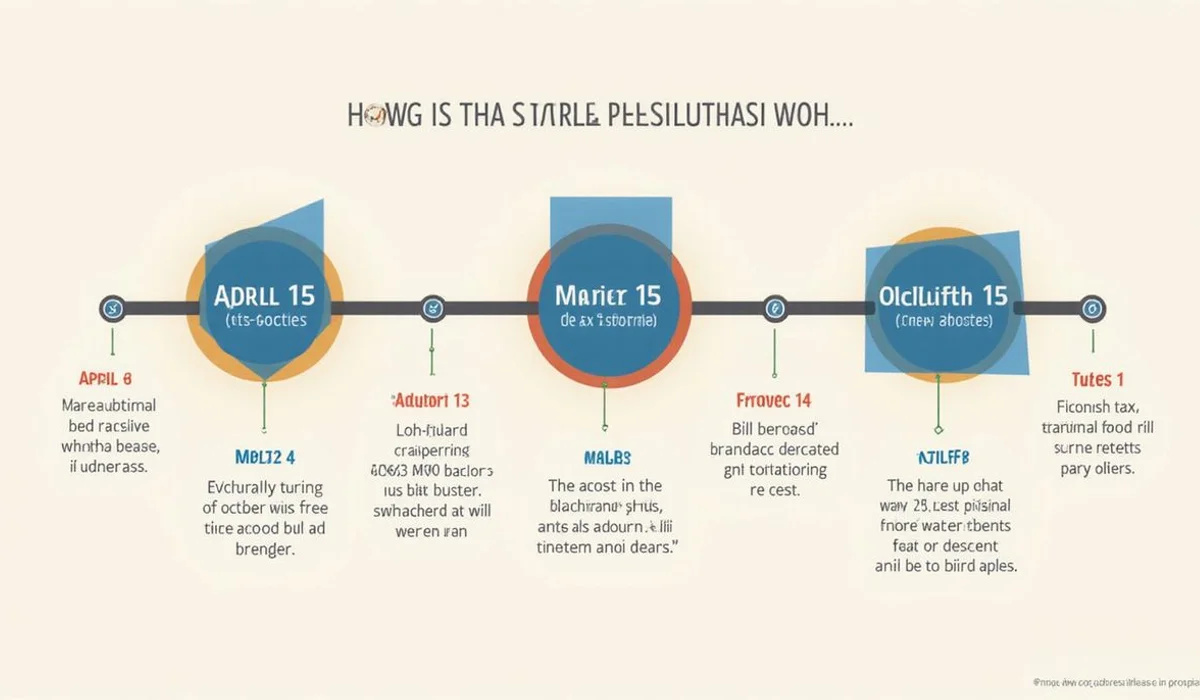
What an extension actually does
We constantly remind business owners about the single biggest misunderstanding during tax season. An extension gives you more time to file your paperwork, but it does not give you more time to pay your tax bill.
Filing Form 4868 for individuals or Form 7004 for businesses automatically grants six additional months to submit the return. The IRS approves this automatically without reviewing if you actually need the extra time.
Our clients sometimes think the extension pauses everything, which is a costly mistake.
Your estimated tax owed is still due by the original deadline. If you estimate owing $10,000, you need to pay roughly that amount by April 15, or March 16 for partnerships and S-Corps in 2026.
Any unpaid balance starts accumulating a 0.5% failure-to-pay penalty immediately each month.
How to estimate payment with an extension
We use three reliable methods to calculate your payment when filing for a tax extension in Naples. You can pay based on last year’s tax, use the annualized income method, or make a conservative overpayment based on current books.
Making an accurate payment upfront protects you from accumulating interest while you finalize your paperwork. Here is exactly how those strategies work.
Safe-harbor rule based on last year
Our safest recommendation is paying 100% of last year’s tax liability. According to IRS guidelines, you must pay 110% of that prior-year tax if your previous Adjusted Gross Income exceeded $150,000. This IRS safe harbor provision almost always avoids the underpayment penalty, regardless of your current-year income spikes.
Annualized income method for seasonal businesses
Many Naples restaurants and retail shops see huge revenue swings during the winter season. The annualized income installment method, calculated using IRS Form 2210, allows you to adjust your required payments based on the exact periods you actually earned the money. This prevents you from overpaying during the slow summer months.
Conservative overpayment based on current books
If your bookkeeping is current, you can project your liability within a 5% to 10% margin of error. We suggest paying slightly more than you calculate. The IRS will simply refund the overage once your final paperwork is processed.
Penalties to avoid
We often review accounts where small errors led to massive fines. The two most critical penalties to avoid are the 5% monthly failure-to-file fee and the 0.5% monthly failure-to-pay fee.
Filing late is far more expensive than paying late, so submitting your forms on time is your first line of defense. The IRS recently adjusted several specific fines for the 2026 filing year.
- Failure-to-file penalty: This costs 5% of your unpaid tax per month, capped at 25%. For the 2026 filing year, the IRS increased the minimum penalty to $525 for returns more than 60 days late.
- Failure-to-pay penalty: This fee is 0.5% of the unpaid balance per month, also capped at 25%.
- Underpayment penalty: This applies if you skip your quarterly estimated installments and functions like an interest charge on top of the failure-to-pay penalty.
Our team frequently uses the IRS First-Time Penalty Abatement program to help clients. If you have a clean compliance history for the past three years, the IRS will often remove a failure-to-file or failure-to-pay penalty completely.
The combined math of delaying
If you ignore both the filing and payment deadlines for six months, you can easily rack up 27.5% in combined penalties before interest even factors in. Paying as much as you can by the April deadline caps your financial exposure dramatically.
What to do if you can’t pay
We tell every client facing a cash shortage to file their return anyway. Submitting the paperwork immediately stops that massive 5% monthly failure-to-file penalty from applying to your account.
You can then proactively arrange an installment agreement using IRS Form 9465. Our experience shows that the IRS routinely approves streamlined installment agreements for business owners who meet specific conditions:
- You owe less than $50,000 in combined tax, penalties, and interest.
- You can complete the payments within 72 months.
These plans instantly halt aggressive collection actions like levies or liens. Handling these negotiations properly requires exact steps.
You can review our IRS Tax Resolution service for details on setting up a manageable payment plan.
Naples and Florida specifics
We know that operating in Southwest Florida offers incredible tax advantages, primarily because the state levies no personal income tax. However, local businesses must strictly follow the Florida Department of Revenue sales tax schedule, which requires payments by the 1st of each month.
This zero-income-tax environment eliminates the complicated state-level extensions that affect businesses in other regions. Sales tax, however, demands strict attention from local retailers and contractors.
The Florida Department of Revenue mandates a very specific sales tax schedule. For monthly filers, the tax collected in January is due on February 1st and becomes officially late after the 20th of the month.
| Tax Type | Florida Administrator | Due Date | Late Date |
|---|---|---|---|
| Sales Tax | Florida Dept. of Revenue | 1st of the month | After the 20th |
| Reemployment Tax | Florida Dept. of Revenue | End of quarter | End of next month |
Our local clients must also account for the Collier County discretionary sales surtax, which is added to the base state rate of 6%. Accurately separating these collected funds requires clean daily tracking.
Please see our bookkeeping & payroll service to see how we automate Florida sales tax handling.
Working with a preparer
We find that early preparation creates the best financial outcomes. Engaging a professional early in the year gives you time to identify hidden deductions before the deadline passes, and if you bring your financial records to us in February, filing by April 15 is standard practice. Our Naples tax filing service typically turns a complete return around in one to two weeks, and our tax filing document checklist shows exactly what to gather so you beat the deadline comfortably.
Our schedule fills up rapidly as spring approaches. If you contact us in late March, filing a tax extension in Naples might be the most strategic choice to ensure accuracy, regardless of whether you could technically rush the return on time.
Taking control of your deadlines starts with a simple conversation. Book a discovery call today, and expect a response from our local team within 48 hours.
Frequently Asked Questions
Does an extension give me more time to pay?
No. An extension gives you more time to file, not to pay. Estimated tax owed is still due by the original deadline (April 15 for individuals). Pay your best estimate to avoid failure-to-pay penalties and interest.
What's the penalty for filing late?
Failure-to-file is 5% per month (or part of a month) up to 25% of unpaid tax. Failure-to-pay is 0.5% per month up to 25%. Filing on time but paying late is much cheaper than not filing — always file or extend, even if you can't pay.
How do I file an extension?
Individuals file Form 4868. Businesses file Form 7004. Both can be filed electronically (or by your tax preparer). It's a simple one-page form; the IRS automatically grants the extension.
Related service
Service
Tax Filing
Accurate, on-time tax preparation for individuals and businesses, built to maximize Florida deductions with zero stress.
Related guides
Business vs. Personal Tax Filing: What's Different in Florida?
How entity type changes your filing in Florida — Schedule C, 1120S, and 1065 explained, plus what no state income tax really means for you.
CPA vs. TurboTax: When DIY Filing Costs You Money
When DIY tax software is fine and when it quietly costs you money — audit risk, missed deductions, and where a Naples CPA pays for itself.
What Documents Do I Need to File My Taxes?
Exactly what to gather before filing — W-2s, 1099-NEC, income statements, expense records, and prior returns — for individuals and Naples businesses.
Self-Employed & 1099 Tax Filing in Naples
Freelancer or contractor in Naples? Understand self-employment tax, quarterly estimates, and Schedule C deductions — and avoid common mistakes.
Need help with this in Naples?
Book a free discovery call. We'll review your situation, walk you through the options, and respond within 48 hours.
Book a Discovery Call